Saturday, April 8, 2023

RIGHT WHALE SEASON REVIEW

 Thank You

The 2023 right whale season in the southeastern U.S. is over, the whales are enroute or have arrived in the feeding grounds to the north. Our data and photos have been submitted to the central repository, the right whale catalog, at the New England Aquarium in Boston. Here, we are cleaning, packing, and storing our gear. Sara departed on Friday, March 31, for her home in Maine. Jim departed for his home on Cape Cod in Massachusetts later that week.

First and foremost, as we have done for previous years, a huge thank you to our capable and dedicated volunteers. Our mobile teams have logged 4,500 hrs of lookout time, while our condo teams have logged another 1,000 hrs. Then too, there are the educational and outreach efforts―brochures, phone cards, and information was  provided to curious citizens, beach goers, walkers, and visitors.

Next, happily, volunteers bring skills. You have taken photographs, flown drones, and made observations. Every contribution enhances our results and makes our volunteer network stronger.

A monstrously HUGE thank you to everyone.

Season Summary

In this, our 23rd season, we had a total of 14 sightings. We had one mother-calf pair, Archipelago, female #3370 with her third calf. We had eight sightings of this pair within five consecutive days, 8 through 12 January. The mother-calf activity, for us, was compressed to one pair and one week.

Beyond that, we had a number of singles. On 10 January, Team 1N sighted the  2022 calf of #3430. It was also seen on 11 January off Beverly Beach. On 31 January, a yearling, the 2022 calf of #2753, was sighted by Team 3 at their first stop, at 8:05 on a Tuesday morning. Finally, a boater reported a sighting off St. Augustine on the morning of 2 February. This individual has been identified as another yearling, the 2022 calf of #1245. As the day progressed, another single, provisionally identified as #4908, a 4 y.o. male, was seen off Marineland, and late in the day, off Flagler Beach.  

This season included a number of beachcast animals. On 26 January, Team 1N discovered an ocean sunfish, Mola mola, off Ponte Vedra. On 11 January, a dead beached female killer whale, Orcinus orca, came ashore at Jungle Hut Road. And, late in the season, on Friday, 24 March, a 16 ft long female Gervais’ beaked whale, Mesoplodon europaeus, beached at South Flagler Beach. Both the killer whale and the beaked whale were recovered by stranding specialists from Hubbs SeaWorld. 

The Big Picture

Based on records compiled by the Florida Fish and Wildlife team, there were a total of 49 right whales (+ 11 calves) in southeastern U.S. waters this season. While there were no large groups as we have seen in some previous years, there was diversity, as 14 males also made the trip to these waters. The 14 sightings by the Marineland Right Whale Project (see below) were a decrease from the previous year. Overall, the population stands at 340 individuals as of the end of 2021 (graph below).

Verified right whale sightings by the Marineland Right Whale Project during the 23 years of the program. Sightings in the last five years showed a promising increase followed by a disappointing decrease.

The cumulative sightings of right whales by all groups during the 2023 SEUS season.  The yellow symbols are mother-calf pairs. The plot includes resightings of the same pairs/individuals. 

Population estimates for the North Atlantic right whale as of the end of 2021. 

Donations

At our season-end party, as we always do, we put out a request for donations. Many responded, and we have $3,500 in hand. Checks continue to appear in our mailbox. But, we’re not quite there yet (we need to raise about $8,000 from the private donations part of our fundraising endeavor). Therefore, if you are willing and able, please write a check for $100 (larger or smaller is o.k. too), made out to Associated Scientists at Woods Hole (or simply ASWH) and mail to Jim Hain, ASWH, P.O. Box 721, Woods Hole, MA 02543. The cumulative effect of your donations help keep this program viable.

Videos

The most excellent video that Sara showed at the season-end meeting, “2023 Volunteer Teams,” is available at our YouTube channel, Marineland Right Whale Project.

As an alternative to searching: the direct link is: youtube.com/@marinelandrightwhaleprojec4079

Another video, done by Flagler College students is being finalized and will be posted shortly on our channel. 

And finally,

Thanks again to everyone.  See you in January for our 24th season.  Stay healthy.

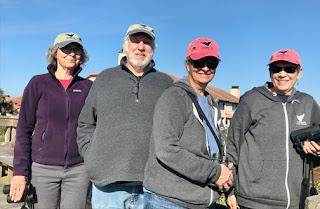
Jim and Sara.  (Photo: B. Gough)


Monday, March 13, 2023

END-OF-SEASON EVENT

 Mark Your Calendars !

The End-0f-Season Event will be held from 2:30 to 4:30 PM on Saturday, 18 March, in the auditorium at the University of Florida’s Whitney lab in Marineland. Signage will guide you to the auditorium. The first half will be a social hour, with a raffle, gear sales, and more. This will include a “light” pot-luck event. Please bring finger food or desserts. We will provide coffee, beverages, plates, and utensils. At 3:30 we will give a presentation with a look back at the 2023 season. 

The event will include images of our volunteer corps, a video by Flagler College students, and a Season Summary . . . analyses, philosophies, and questions. What are we learning and what secrets are the whales withholding?

In these times of a continuing covid pandemic, masks are welcome (use your judgment), but not required.

We have a network of many wonderful folks! See you Saturday!

Thursday, March 9, 2023

BLUEBIRD DAYS

Gosh! In 20+ years of the program, I can’t remember this kind of weather. Calm seas (often sea state 2, except on Saturdays), light westerly winds, and warm sun.  The meteorologists report record warmth. Likewise, water temperatures are warm.

Synopsis
Our last mother-calf sighting was from Hammock Dunes, Old Salt Park, and then Surf Club on 12 January . . . catalog #3370, Archipelago, and calf. Since then, we have had reports of fleeting and elusive singles . . . on 31 January, 2 February, and 17 February. A sighting on 23 February went unverified.

Our one-and-only mother-calf pair for the season, Archipelago, made a strong showing early on. And then, went absent. The records compiled by the Florida team show that they were sighted periodically in northern Florida and southern Georgia. The most recent sighting was on 15 February, off St. Simons Island, Georgia.  

And, the one and only mother-calf pair, Pilgrim and calf, sighted by our partners to the south, the MRC, was seen by them on 18 and 19 January in Vero Beach, and most recently seen on 9 February, off Cape Hatteras, and heading north.

Indications are that this was an early and warm season, with a smallish number of right whales. (The number of right whales here in the southeastern U.S. is not so different from last year.)

But, don’t despair. We have experienced these kinds of seasons before. Remember that, “every day, every season, and every whale is different.” We’ll continue with a strong survey effort for the remaining two weeks, right through 12 March.  

Mid-Year Highlights

After a hiatus of two years due to the pandemic, we held a mid-year meeting on 11 February.  We passed out questionnaires, had a raffle, and had brisk sales of “whale gear.” Jim and Sara gave presentations. The pot-luck “snack buffet” had many treats, two of which were the carved “right whale watermelon” by Greg Tougas and the “right whale cookies” by Carole Adams.  Most excellent.

Examples of the wonderful treats at our mid-season event on 11 February.

Mark Your Calendars

Our last dedicated survey day of the 2023 season will be on Sunday, 12 March.

Student Visit

From Monday, 20 February through Friday, 24 February, we mentored a student from New York. Kyriaki (Kiki) Gavriil is a junior, enrolled in a science research program, at Byram Hills H.S. in Armonk, NY. While here, she also visited with the Florida Fish & Wildlife team.

During the week of 20 February, we worked with Kyriaki (Kiki) Gavriil, a student from Byram Hills H.S. in Armonk, NY.

Flagler Video

We’re working with Brooke and Macie from the Flagler College digital media and communications program, on a right whale video. Jeff and Sue, along with Glenn from Team 2 were interviewed. Sara was also interviewed. We will likely show this video at the upcoming year-end meeting.

The Numbers

Currently, the number of calves born this season stands at 12. One died off of North Carolina. The number of “alive” calves stands at 11. Early on in the season, we were hoping for a calf production in the 20s, with a continuing hint of a small rebound. It appears now that this will not be realized. We, along with other investigators, are studying water temperatures and other factors. 

Thank You

As we wind down for this season, thanks to everyone for your good efforts.


Thursday, February 2, 2023

THE ACTION PICKS UP AGAIN

 A Lull, Then a Sighting
On 12 January, we had our last sighting of Right whale #3370, Archipelago, and calf off the Hammock, and later in the day, off the Surf Club. This was followed by a lull of more than two weeks. Then, at 8:05 on Tuesday morning, 31 January, Surveyor Judy Bowman had a sighting at her first stop (the upper deck of the Oceanside restaurant in South Flagler Beach). A single individual, just at the fog line, moving south rapidly. Surveyors Peggy Jones, Elaine Kelley, John & Linda Wilson, Michelle Ross, Tracy Tougas, Pat Cotton, and others responded. Some were rewarded with an active whale just off Gamble Rogers State Park. The whale’s speedy southward movement soon resumed. By getting ahead of the whale, Sara captured a few drone images off High Bridge Rd. (within North Peninsula State Park) before the whale disappeared from sight. The individual was identified as a yearling, the 2022 calf of female #2753 (Arpeggio). The yearling’s gender is unknown, but it has a white belly and chin. 

This yearling, the 2022 calf of #3370, Arpeggio, was spotted traveling south from Flagler Beach on 31 January. Image: Sara Ellis, research permit 26562.

The drone automatically records flight data.  This map shows the path flown by the drone from the High Bridge Road overlook to capture video and photos used to identify the whale sighted on 31 January.

The Facebook page of the “Mid-Atlantic Baleen Whale Monitoring Project,” describes that this individual was sighted next to the mouth of Chesapeake Bay on 18 January. The page contains a number of interesting photos of the yearling moving through busy shipping channels.

Not Only Whale Sightings
Our previous post described the killer whale that came ashore on 11 January. Shortly thereafter, a deceased ocean sunfish (Mola mola) was discovered by Survey Team 1 North on Thursday 26 January. It was at their lookout point in Ponte Vedra Beach just north of the Guana-Tolomato-Matanzas National Estuarine Research Reserve facility. Ocean sunfish are the largest bony fish in the world, reaching up to 10 feet in length; this particular individual wasn’t that big, but was still pretty impressive at 5 feet long. The team reported the sighting to the Fish Kill Hotline of the Florida Fish and Wildlife Conservation Commission, who sent out a biologist to take tissue samples. The team stayed with the carcass until then and admired the oddly beautiful creature.

A deceased ocean sunfish (Mola mola) was discovered by Team 1 N on Ponte Vedra Beach on 26 January 2023.  Pictured, left to right, Tammy Taft, Matt Heck, and Adrienne Cilliers.  Image: Shea Lox

Community Talks 
On Saturday, 4 February, Sara will give a talk at Gamble Rogers State Park. This is mostly for new people. The program is free with paid park entry and a reservation is  required. Phone (386) 517-2086.

Whales, Weather, Waiting, Watching
Our years of experience have taught us that the whales and the weather are unpredictable. At this time, the 2023 calf count stands at 11. We would like more.  Maybe numbering in the 20s. Although mother-calf pairs are currently absent from our survey area, there are reports to the north of us, off Georgia. Will there be reports of additional calves? Will we see mother-calf pairs in our area, perhaps new ones? All will be revealed. But not on any predictable schedule.  

As always, here’s to “light winds and heavy whales.”

Sunday, January 22, 2023

WE ARE OFF TO A BUSY START

Two Weeks In
In Week One of our 2023 season, January 4 through 10, our volunteer sighting network partners to the south, the Marine Resources Council (MRC), had five sightings, all of female #4340, Pilgrim, and her first calf. The first sighting for the Marineland Right Whale Project came on 8 January, female #3370, Archipelago, with her third known calf, off Crescent Beach, heading south. This pair was sighted two more days in a row by the MRWP in Flagler Beach and then Daytona Beach. A single yearling, the 2022 calf of female #3430, was sighted off Ponte Vedra on 10 January.

Week Two began on 11 January. The single yearling was sighted again off Beverly Beach on the 11th. Singles were also sighted off the Nautilus Condo late in the day on the 17th and on the 18th off New Smyrna Beach and further south off Port Canaveral. 

Occasionally we see juvenile right whales, such as this yearling, which was photographed by drone off Beverly Beach on January 11, 2023. Image: Sara Ellis, research permit 26562.

Archipelago and her calf turned northward and were sighted by the MRWP off Ormond Beach on the 11th and off the Hammock on the 12th. To the south, Julie and Joel of the MRC continued to monitor Whale #4340 Pilgrim, most recently sighted off Sebastian Inlet on the 18th.

To date, there are 10 calves this season. We hope for more. A number in the 20’s would be good. Some days, we have sightings. Other days, we do not.  Each day, we wake up and say (with conviction), “Today’s the day.” !

The weather for the start of the season has been remarkable. With the exception of two cold and windy days, where we cancelled the dedicated surveys, we’ve had many days with light winds and calm seas. I can’t remember such a frequency of good conditions in Januarys past.

Beach Surprise
In addition to seeing right whales, over the years of our program we’ve had many beach surprises. Animals that have come ashore or washed up include ocean sunfish, pygmy sperm whale, fin whale, and on 14 February 2018 the upper jaw of a humpback came ashore at the Flagler Beach Pier.

Most recently, on 11 January, the carcass of a female killer whale Orcinus orca, came ashore at Jungle Hut Road. This is only the third time a killer whale has been found stranded in the southeastern U.S. and the first time in nearly 70 years—so a rare event indeed. Members of the local marine mammal stranding network worked all day to remove the carcass from the beach and transport it to a facility for examination. It is too soon to know the exact cause of death, but early indications are that she was an old female with no injuries, but with signs of illness. 

We see more than right whales.  Here, a beached killer whale, Orcinus orca, off Jungle Hut Road, on January 11, 2023.  Image: Martha Garito.

We’ve had an eventful start this season.  What will the next few weeks bring?  As always, let’s all raise a glass to . . . 

“Light winds and heavy whales”

Monday, January 9, 2023

RIGHT WHALE SEASON HAS BEGUN !

Our first mother-calf for 2023
Late in the day on Saturday, January 7th, the Florida Fish & Wildlife Team reported a sighting just north of the St. Augustine Inlet, traveling south. It was Right Whale #3370, Archipelago. This is a whale known to us, we sighted her in several previous seasons. We were optimistic. We alerted the teams.

Early the next day, our FWC colleagues called to report a public sighting in Sector One (St. Augustine and Crescent Beach). We alerted Team One. They called back shortly thereafter - whales north of the Crescent Beach Park walkover. Sara flew the drone. Kim Jacomo took photos from shore with our new Nikon Coolpix P1000 24-3000mm camera. We used our One-Call-Now (robo-call) system, and many folks came out to have a look. This is calf #3 for Archipelago. When last sighted today, the pair was just north of the Matanzas Inlet. Here's hoping for additional sightings this season.

#3370, Archipelago, from Crescent Beach Park, 8 January 2023.  
Image: Sara Ellis

#3370, Archipelago, from shore, 8 January 2023.  
Image: Kim Jacomo

Team One, whale sighting, 8 January 2023.  Image: Sara Ellis

The 23rd Season
The 23rd season of the Marineland Right Whale Project had its kick-off meeting in the afternoon of Tuesday, January 3rd. It was held in the customary location - the auditorium at the University of Florida's Whitney Laboratory in Marineland. We had a good turnout, with 130 both returnees and new volunteers. The dedicated surveys began the following day, on Wednesday the 4th.

Pilgrim, Right Whale #4340
She got by us! On December 30th, staff from the Marine Resources Council (partners in the Volunteer Sighting Network) responded to a call and documented the 9th mother-calf pair for the season. They photographed the pair to the south, near the Apollo Beach ramp, Canaveral National Seashore, in fading light around sunset. Interestingly, the pair (or perhaps in some cases, the female alone prior to birth) went past North Carolina, South Carolina, Georgia, and Northeast Florida without being reported. It happens! It reminds us of the nature of our work and the elusive nature of at least some whales. BTW, this is Pilgrim's first calf, she is a first-time mother!

Resources
Along with this blog, other great resources to learn more about right whales and how to spot and report sightings are the Team Handbook, the 2022 annual report (both at aswh.org), and Right Whale News (at narwc.org).

Sunday, May 1, 2022

SNOW CONE UPDATE

Snow Cone, #3560, and calf were last spotted by the Marineland Group on 17 February off Ormond Beach. Then it got quiet. We waited. Two months and a thousand miles later, Snow Cone and calf were sighted east of Cape Cod by the Center for Coastal Studies aerial survey team. The sightings came on Saturday, 23 April, and Sunday, 24 April. Scott Landry, of the Entanglement Response Center, describes that the overall condition and entanglement of Snow Cone seems no better or worse than that of the February sighting. Scott describes that she is now thinner and the wound around her rostrum is more apparent. The wrap of rope around her rostrum is complicated by the baleen at the front of her mouth.  


Snow Cone is well known. Recall that Snow Cone lost her first calf in 2020 but reappeared in December 2021 with another calf. Resilient. She was prominently shown in the Last of the Right Whales documentary.


There is further news from Cape Cod. #2360, Derecha, and #2040 Naevus, were sighted in Cape Cod Bay by the CCS team on 13 April.  Of the three mother-calf pairs seen by the MRWP during the 2022 season, all have successfully made the northward migration and appeared in the Cape Cod area. 


As for Snow Cone, there is caution and uncertainty about the entanglement, wound, and overall condition.  Feeding was observed for the Cape Cod sighting.  A good thing.  However, ongoing monitoring is underway.  We are hopeful for a good outcome:  A healthy reproductive female, and an additional member of the right whale population.

Wednesday, March 23, 2022

THANK YOU


As the 2022 season draws to a close (it’s been quiet for two weeks now, probably the whales are gone, headed north, toward Cape Cod and Canada), a huge thank you to the many volunteers and responders that contributed to our results this season.


Video

Our new five-minute video entitled 2022 Volunteers shows snapshots of our dedicated and capable volunteer corps. Go to YouTube, and then Marineland Right Whale Project, or, click here.


Last of the Right Whales film

At our season-end wrap-up event on Saturday afternoon, 19 March, we showed the most excellent film, Last of the Right Whales. Sara and several of our volunteers were prominently included. The film will likely receive wide distribution; if and when it airs on PBS we will notify you. In the meantime, there are wonderful excerpts and featurettes available. Go to YouTube, search on HitPlay Productions, and then select Videos, or click here, to find nearly two dozen 2-minute clips. Ones that we particularly like are: the Official Trailer; Meet the NARW Citizen Scientists; Behind the Scenes: Music; and, The Making of LOTRW..


For upcoming screenings:


* Cape Cinema (Cape Cod) Dennis, MA, 24 March 2022, 7:00 p.m.


* Patriot Cinemas, Nickelodeon, Portland, ME, 27 April 2022, time TBA.


* Salem Film Fest, Peabody Museum, Salem, MA, 26 March, 11:00.  It is also available for streaming 28 March through 3 April. Streaming tickets are available here for $10.


As additional dates and locations are added, they will be listed at lastoftherightwhales.com/screenings/.


Right Whale News Posted

The March 2022 issue of Right Whale News has been posted at www.narwc.org.  Select Right Whale News, and Current Issue from the Menu bar.


Whale Gear

The sale of whale gear at our season-end event was vigorous. We have some caps, pins, long- and short-sleeved T-shirts, and hoodies left. If you would like some of these, come by the office prior to 31 March (call Sara (207) 281-3541, or Jim (904) 923-5050, between 9 and 2, to  make sure we are here.) Checks or cash only.


Donations

As we have done for many years, we put forward an appeal at the end of the current season. Throughout the year we apply to foundations and organizations for support. This covers the majority of program costs. We now appeal to you to help fill the shortfall, typically a few thousand dollars. This is not insurmountable. Just like the rest of the program, the collective effort makes things happen. Donations are tax-deductible. Please make checks out to Associated Scientists at Woods Hole, or simply ASWH, and mail to Jim Hain, ASWH, Box 721, Woods Hole, MA 02543.  We are requesting donations of $100, but any amount is very welcome.

Monday, March 7, 2022

15TH CALF OF THE SEASON !!

Good news! We have a new mother, bringing the total to 15 right whale calves so far ! Female #4180 and her 2nd calf were sighted off North Carolina on 2 March. The calf was just a few days old. A range of birthdays is expected and this is one of the reasons why the right whale calving ‘season’ spans the months of November through April.

Right Whale Talk at Flagler College

Flagler College Forum on Government and Public Policy presents a lecture delivered by award-winning reporter and photo- journalist for the Boston Globe, David Abel on 8 March at 7:00 p.m. He will present “Entangled - The Race to Save the North Atlantic Right Whale.” This event at the Lewis Auditorium, 14 Granada Street, St. Augustine, is free and open to the public.

Are We Done ?

Our most recent sighting was on 22 February at the Flagler-by-the-Sea Campground. The mother-calf pair, Derecha and calf, subsequently swam south. Since then, it has been quiet. Are we done with sightings for the season? Always the optimists, we hope for future sightings and surprises. Please continue look out to sea whenever you are on the coast and keep handy the Right Whale Hotline phone card included in an earlier post just in case you are lucky enough to spot one!

Last Survey Day

The final day of dedicated surveys for the Marineland Right Whale Project is Sunday, 13 March. However, we will continue to be available to respond to any sightings called into the Right Whale Hotline.


Saturday, February 19, 2022

SNOW CONE SURPRISE

And this is why we do this.

On Wednesday, 16 February, Team 2 reported whales off Marineland. There was an east wind, with a sea state of Beaufort 4. The whales, whoever they were, were distant, surfacing briefly, spending time submerged, and moving south quickly. We worked. We worked the sighting down past Surf Club, Washington Oaks, Malacompra, 16th Road, and Varn Park. Sara made five drone flights and expended five batteries. The sea state remained at 4 the entire day. The whales traveled 7 nautical miles in 8 hours. We got neither a close look nor any photos.

We were to get another chance. On Thursday, 17 February, FWC relayed a report of whales in Ormond Beach, a mother-calf they said. We alerted Teams 4 and 5. By 10:00 we were on the deck of the Cardinal Street Beach Patrol tower-searching. No joy. Then down to Andy Romano Park. Again, no joy. We spaced our volunteer spotters throughout the area. At 10:50 we sighted blows from a lookout point in an empty lot. Sara launched the drone. Some excitement. The video monitor showed the images transmitted back from the drone-Snow Cone!

We had seen Right whale #3560, Snow Cone, on two previous occasions this season. Additionally, FWC reported that she and calf had been seen fairly regularly from 2 December to 24 January, then they dropped off the radar screen. There was a possible sighting (not 100% confirmed) off Georgia on 12 February. And then-the Ormond sighting.

You may recall from the email of 14 January, that this remarkable female lost her 2020 calf, and with great resilience rebounded to produce another calf, all while entangled. The images below show the rope going in one side of her mouth, coming out the other side, and trailing behind. Snow Cone’s overall condition seems good, but the wound on her forward rostrum is of concern. Her (male) calf looks both rambunctious and healthy.


Snow Cone and calf, 17 February 2022, Daytona Beach.  (Photos: Sara Ellis, permit #20626.)

Responders to the sighting on 17 February 2022.  (Photo: Vinnie Palazzolo)

We will be on alert for additional sightings and photos before the pair heads north. Strong best wishes for survival of Snow Cone and her calf.

And, oh yes, World Whale Day is this Sunday, 20 February.

Friday, February 11, 2022

MOVIE NIGHT

Mark your calendars.

In 2020 and 2021, the Marineland Right Whale Project participated in the making of the Canadian documentary, Last of the Right Whales. Upcoming is an opportunity to view this excellent film.

The Florida premiere will take place at 6:30pm on Wednesday, 23 February, at the historic Sun-Ray Cinema, 1028 Park Street, in Jacksonville.  Afterwards, Dinah Pulver, environmental reporter for USA today,  will moderate a panel discussion with Sara Ellis, Julie Albert, and Nadia Gordon.  Tickets can be purchased online here.  


Masks are recommended.

Watch the Official Trailer

Recent Promotion featuring Snow Cone

Thursday, February 3, 2022

TWO SISTERS

The two whales in the two days of the second month were interesting.

At 10:30 on Tuesday the 1st, Mike Adams with Team One at Green St. called. Whales up to the northeast.  The spotters included Sue and George Miller. 

At mid-morning on Tuesday, 1 February, sharp-eyed Team 1 had a distant sighting. The story unfolded during that day and the next. People, the Beach Patrol, planes, and drones all contributed.

We responded, first going to Crescent Beach and then Butler Beach. From Butler Beach, we briefly saw distant blows and backs. And then, nothing. As it was too far and too elusive for us to launch the drone, we relayed the sighting information to FWC and their aerial crew. Shortly thereafter, two whales were photographed from the plane. They were two adult females, #3890, Babushka, and #4190, Curlew. The last two digits of their catalog numbers aroused our curiosity. They were both offspring of female #2790, and . . . they were sisters. There’s more. They are both listed as potential mothers. 

The next day, Wednesday the 2nd, Jen with the FWC called. Whales in Ormond-by-the Sea. We alerted responders in the area and got on the road. After several stops with no sightings, a call with the Beach Patrol got us connected. We quickly went to Andy Romano Park in Ormond Beach, but needed to go further south. We got in a single drone flight in increasing winds and sea state. It was the two sisters.  Their behavior was similar to the previous day but different from what we generally observe from mother-calf pairs . . . they were surfacing briefly and doing extended submergences.  And, they were moving quickly.

The two sisters, Babushka and Curlew, heading south off Ormond Beach, 2 February 2022.  (Drone image, S. Ellis, Permit #20626)

Afterwards, we wondered . . . do they know that they are sisters? Is there a communication or bonding? Are they both pregnant? Will they both have calves this season?

We are reminded that there is a lot we don’t know, but our curiosity is piqued.

And finally, even though our One Call Now system is in place, because of the difficult sighting and deteriorating conditions, we didn’t use it on this occasion.

A short stop on the way home from a sighting. The data are recorded and the images are in the can.

Tuesday, January 25, 2022

DERECHA RETURNS

Things change. We can’t predict. We last saw Catalog #2360, Derecha, right off the boardwalk here at Marineland, on 10 January. Bill Gough photographed her breaching (image below). The pair swam north.  

Breaching whale, off Marineland, 10 January 2022.  (Photo: Bill Gough)

Then it got quiet. On 15 January they were seen off Talbot Island, north of Jacksonville. Were they heading north? Well, no. On Sunday the 23rd, the phone rang. Julie Albert with the Marine Resources Council's Right Whale Hotline called with a sighting reported on FaceBook. At about the same time, team member Jim Sullivan reported a sighting from just N of the Flagler Pier. Jim wasn’t on duty. He and his wife were on the way to an anniversary lunch. They kept them in sight until further responders arrived. The FWC aerial team identified the mother as Derecha. and calf. On a drone flight, Sara got images of the belly-up calf, showing a spectacular white belly, and identified the gender as female (image below).  

The 2022 female calf of Derecha.  (Photo: S. Ellis)

Shortly thereafter, they were sighted from Gamble Rogers State Park. Martha Garito got photos from Highbridge (image below).

Derecha and calf off Highbridge, 23 January 2022.  (Photo: M. Garito)

The next day, Monday the 24th, the phone rang at 07:38. Lou Reinwasser, Team 5 N, called in a sighting from Grenada Park in Ormond. Sara got drone images. Derecha and calf, heading S.

Late in the day, the FWC plane reported Snow Cone and calf from Washington Oaks. Shortly thereafter, Donna McCutchan reported them from off Sea Colony. This was another surprise, as they had been last seen up by Amelia Island on Wednesday the 19th.  

So, as of yesterday, we have had two mother-calf pairs in our area > > > the two “remarkable females” described in our previous post.

We have seen repeated  down-and-up/south-and-north movements from both of these pairs. Both were last seen heading south. What does the future hold? 

Friday, January 14, 2022

TWO REMARKABLE FEMALES

 We have two remarkable females in our area this season―Derecha and Snow Cone. Both have a history and a story.  As so often happens in life, the story is bittersweet.

Derecha, Catalog #2360, had her 4th calf in the 2020 season. Of the 10 calves born that season, one, that of #2360, Derecha, was injured, apparently within days of its birth. The calf was spotted off Georgia on 8 January with injuries that were consistent with a propeller strike. The injury was judged to make it unlikely for the calf to nurse or survive.  The calf has not been seen since 15 January. But, just under two years later, Derecha was seen off Florida on 18 December 2021 with her 5th calf. She has been seen in our area several times since. 

Next, Catalog #3560, Snow Cone, early on had evidence of previous gear entanglements, as her peduncle was scraped and scarred. At the age of 15, female Catalog #3560 had her first known calf in early December 2019. The exact date and location are unknown, but the event likely took place in Georgia in the first half of the month. The pair was seen frequently during the 2019–20 season. They were popular. But there was to be no happy ending.

After a 2020 season with frequent sightings, the mother-calf pair departed the southeast U.S. and began the northward migration. In the morning of 25 June 2020, a boater reported a floating whale carcass off New Jersey. The dead whale was identified as the male calf of #3560.

It is uncertain whether or not whales grieve or experience pain and emotions, but #3560 might have experienced both.

She continued on the feeding grounds. Additional trauma was in store. On 10 March 2021, #3560, Snow Cone was sighted entangled off Cape Cod. Some line was removed but the entanglement was considered serious.

There is blue sky. On 2 December, Snow Cone was sighted off Georgia―with a calf ! Like Derecha, she had a quick turn-around and a short interval between calves.  Remarkable! 

So, when you see either of these remarkable and resilient females, courtesy and respect are in order.

You may notice that Snow Cone continues to be entangled, and sections of trailing rope can be seen (image below). Folks have asked why is there no intervention or disentanglement?  The answer: at this time, there is great caution and reservation against harassing or impacting the mother-calf pair in the case of a young calf, with a priority on nursing and bonding. Then too, Snow Cone is judged to be reasonably healthy. A judgement has been made by those with expertise that the pair will be given wide berth.

Snow Cone, photographed by S. Ellis from a drone on 13 January 2022, is trailing line (one strand through the mouth) and has a wound on the forward part of the rostrum.  (Permit #20626)

The volunteer sighting network can contribute to watching and documenting and protecting these remarkable females, as well as others that may surprise us as the season goes along.

If you plan to spend time on the coast, please carry the phone card from the previous post and call the Marine Resources Council's Hotline number if you see a whale.

Tuesday, January 4, 2022

SURVEYS BEGIN

The 2022 volunteer sighting network lookouts begin today, Tuesday, 4 January.

To date, 11 Right whale mother-calf pairs have been reported in the waters of the southeastern U.S. Two of these pairs have been reported in the Marineland vicinity.  Others may flow into our area.

In addition, several of the other survey teams to our north have reported reproductive-age females who are potential mothers.

On all counts, we are looking for a strong season within our survey area. If you would like additional tips about spotting whales and how to report your sightings, access the Team Handbook from our website, www.aswh.org (select from lower left on the home page).  

Please download this card and carry it in your wallet.